Guide
How Daily Fantasy Sports Works: Formats, Scoring and a Worked Example
Daily fantasy sports (DFS) is a contest in which you pay an entry fee, make picks from the players in a slate of real games, and compare the points those players earn with the points other entrants' picks earn. Contests last a day, a weekend or one scoring period, so there is no season to commit to. The state of New York's Gaming Commission describes the same idea in its own terms: contestants assemble a roster of athletes and use the athletes' real statistics to decide who wins prizes. This guide shows how daily fantasy sports works from sign-up to final score, format by format.
Continue readingKey note
Daily fantasy sports turns one day or one week of real games into a short contest where your picks earn points from official player statistics.


How would you like to learn how daily fantasy sports works?
The guide sits right below: 5 chapters, about 9 minutes. Jump to the chapter you need.
- What are the main DFS formats?
- How does scoring work? A worked example
- What do entry fees and prizes mean in general terms?
- How do age and location checks work?
- How is daily fantasy sports different from a season-long league?
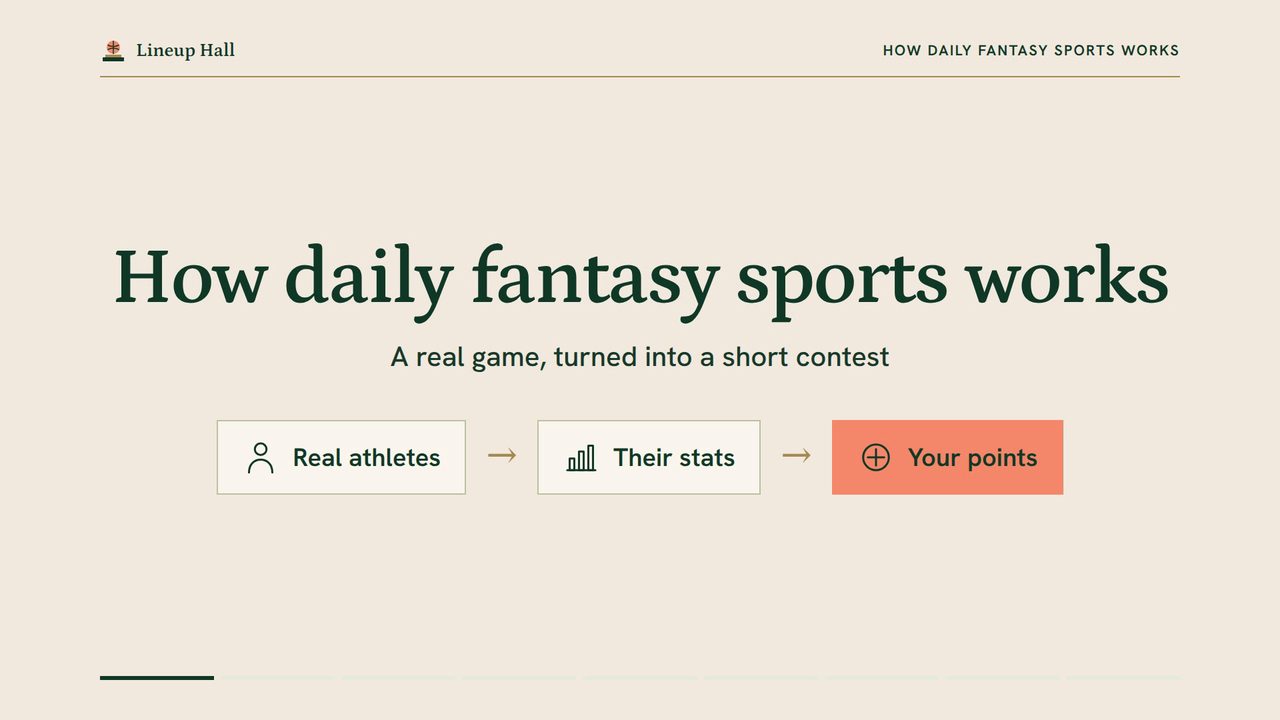
Text of the video
Daily fantasy sports turns a real game into a short contest. You pick real athletes and their stats become your points.
There are five common formats. Salary cap and pick'em come first. Peer-to-peer pick'em is third. Best ball and pools complete the set.
In a salary-cap contest every player has a price. You fill a roster without going over the budget.
In pick'em you choose more or less on a player's stat line. The payout multiplier is shown before you submit.
Best ball works differently. You draft once and your top scorers count automatically each week.
Scoring depends on the platform. Take one receiver with 8 catches and 112 yards. Add one touchdown and one lost fumble.
With a full point per catch that line is worth 27.2. With half a point per catch it is 22.2.
Where you live matters too. Each state sets its own rules and the apps check your location and age.
Rules as of November 12, 2026. 21+. If you or someone you know needs help, call 1-800-MY-RESET (1-800-697-3738).
From format to results
An overview of the process
- Step 1: Format Choose a contest type: salary cap, pick'em, peer-to-peer pick'em, best ball or a pool.
- Step 2: Lineup Fill the roster slots, or make the picks the entry requires.
- Step 3: Lock Submit before the lock time the contest shows.
- Step 4: Scoring Official player statistics become points under the operator's chart.
- Step 5: Results Entries are ranked or paid by the contest's own rules once the stats are final.
What differs between products is how you choose players and how a winner is decided. The sections below cover the five formats you will see on the operators we review, then a worked scoring example with real numbers.
What are the main DFS formats?
Operators name their products differently. The list below uses plain labels and the product names as the operators list them (see the state and operator checker). Which formats you can use depends on the operator and on your state. Each of the formats below is daily fantasy sports in the legal sense: a contest decided by real player statistics.
Salary-cap contests
You build a lineup under a fixed budget, and every player has a price. DraftKings and FanDuel list salary-cap contests as a product, and so do Yahoo Daily Fantasy and others.
- Pick a sport and a contest from the lobby.
- Fill each required , such as a quarterback or two running backs.
- Keep the total of the players' salaries within the cap the contest states.
- Submit the lineup before the lock time the contest shows.
- Your lineup's total points are ranked against the other entries, and prizes follow the contest's prize table.
Pick'em
You choose individual players and decide, for each one, whether a statistic will finish above or below a posted line. Underdog, Dabble and Betr Picks list a pick'em product.
- Choose a player and one statistic, such as receiving yards.
- Choose the higher or lower side of the posted line.
- Combine the number of picks the entry type requires.
- Submit the entry before the first included game starts.
- The entry's applies only if the operator's rules count every pick as correct.
Peer-to-peer pick'em
The same pick structure, but your entry is measured against other entrants, with no fixed payout multiplier. PrizePicks lists "Player Picks (against other entrants)", Betr Picks lists "Group Play (against other entrants)", and Boom lists "Pick'em Royale (against other entrants)".
- Choose the players or statistics the contest asks for.
- Select the side for each pick.
- Enter the contest at its stated .
- Wait for the games to finish and the statistics to be final.
- The contest ranks entrants against each other and pays according to its own rules.
Best ball
You draft a roster and then do nothing else. Underdog lists "Drafts ()" and Yahoo Daily Fantasy lists Best Ball.
- Join a draft and pick players in turn until the roster is full.
- Leave the roster alone, because there are no weekly lineup moves.
- Each scoring period, the platform counts your highest scorers at each position automatically.
- Points add up across the periods the contest covers.
- Final standings decide prizes. Our best ball guide covers the details.
Pools
You make picks in a structured group game, often one pick per week or one pick per game. Splash Sports lists Survivor, Pick'Em, Confidence pools and One & Done.
- Join a pool and read its scoring and elimination rules.
- Make your pick for each round or game before it locks.
- Earn points, or stay alive, depending on how the pool is scored.
- Continue until the pool's final round.
- Prizes follow the pool's own prize table.
How does scoring work? A worked example
Each operator publishes a , and the charts differ. The example below uses the NFL charts as published on November 12, 2026: DraftKings' Classic rules from its NFL rules page and FanDuel's from its rules page. Use the current version on the operator's page before you enter a contest. Seeing one stat line scored twice is the quickest way to understand how daily fantasy sports works on different apps.
Take one invented stat line for a wide receiver: 8 receptions, 112 receiving yards, 1 receiving touchdown and 1 fumble lost. The figures are for illustration only, not a real game.
| Scoring item | Stat | DraftKings points | FanDuel points |
|---|---|---|---|
| Receptions | 8 | 8 × 1.0 = 8.0 | 8 × 0.5 = 4.0 |
| Receiving yards | 112 | 112 × 0.1 = 11.2 | 112 × 0.1 = 11.2 |
| Receiving touchdown | 1 | 6.0 | 6.0 |
| 100+ receiving yards bonus | yes | 3.0 | 3.0 |
| Fumble lost | 1 | −1.0 | −2.0 |
| Total | 27.2 | 22.2 |
The same performance is worth 5 points more under DraftKings' rules, almost all of it from the reception value: 1 point per catch against half a point. A player who catches many short passes gains more under the first chart. That is why experienced entrants read the chart before they read the player rankings. A quarterback's passing yards are worth 0.04 per yard under both charts, so the gap there is much smaller. Our scoring guide and the fantasy points calculator let you try other stat lines.
“Each operator publishes a scoring chart, and the charts differ.”
What do entry fees and prizes mean in general terms?
An entry fee is the amount you pay to join a contest. Operators combine fees into a prize pool and publish a prize table that says what each finishing position receives. Some contests pay a large share of entries a small prize, and others pay only the top few. The contest page shows which structure it uses.
Pick'em entries work differently. Instead of a ranked prize table, the operator's payout multiplier schedule says what an entry returns if its picks are scored as correct. Because every operator sets its own schedule, we do not print figures here. We also cannot tell you what you will win: a lineup can finish anywhere, including with no prize. Set an amount you are comfortable spending before you enter, and read our responsible play page for tools and resources.
How do age and location checks work?
Daily fantasy is regulated state by state, and there is no federal DFS regulator. The operator decides where it accepts entries, and its terms list the states where it does not.
Age limits vary by state. In the operator listings we have read, the default minimum age is 18, with 19 in Alabama and some other states, and 21 in Arizona, Illinois, Iowa, Louisiana, Massachusetts and Virginia for DraftKings. FanDuel lists the same default with 19 in Alabama and 21 in Arizona, Louisiana, Massachusetts and Virginia. These tables change, so the operator's own terms win. Hawaii, Idaho, Montana, Nevada and Washington have no paid DFS from the operators we review. For a state-by-state view, use the checker; for the legal background, see is DFS legal?. When you open an account, the operator asks for your state and date of birth and applies its own verification steps.
How is daily fantasy sports different from a season-long league?
A season-long league runs for months with the same roster, trades and weekly lineup choices. A DFS contest starts fresh each and ends within days.
| Season-long league | Daily fantasy contest | |
|---|---|---|
| Length | A full season | One day or one scoring period |
| Roster | Built once, adjusted all year | Built for each contest |
| Player cost | Draft position or waivers | Salary cap or posted lines |
| Scoring | League settings, such as half or full PPR | The operator's published chart |
| Entry fee | Often league dues | Per contest |
Scoring rules for both are published. Yahoo's season-long default and ESPN's Standard format use different reception values, 0.5 and 1.0 points, on their own help pages, so even two season-long leagues can disagree.
Check your understanding
- What are the five formats described on this page? Salary-cap contests, pick'em, peer-to-peer pick'em, best ball and pools.
- In the worked example, why does the same stat line score 27.2 under one chart and 22.2 under the other? The reception value is 1.0 versus 0.5, and the fumble penalty is −1 versus −2.
- What is the one thing to do before you enter a contest? Read the operator's current scoring chart and rules for that contest.
- Which part of a pick'em entry is set by the operator and not by you? The payout multiplier schedule.
- Who decides the minimum age and where an operator accepts entries? The operator, within state rules, as shown in its terms.
Frequently asked questions
Can you make money playing DFS?
Some entries earn prizes and many do not. We do not state or imply expected results. Results depend on the contest, the field of entrants and the games, so plan on the entry fee as money spent.
Is daily fantasy sports legit?
Operators list their state-by-state availability in their own terms, and we show it as listed. Legality varies by state and in some states is contested. See our legal guide for the details.
What are daily fantasy sports and how do they work?
You choose players for a contest, the players earn points from official statistics, and your total is compared with other entries or with a posted line. The sections above show each format step by step.
How does daily fantasy sports work for football?
You use the same formats with NFL players and an NFL scoring chart. Positions, such as quarterback and wide receiver, and rules for late changes vary, so read the contest page. See our fantasy football hub.
In what states is DFS not offered?
It varies by operator. Hawaii, Idaho, Montana, Nevada and Washington have no paid DFS among the operators we review, and California is held pending a legal review. See the state checker.
What is the difference between daily and season-long fantasy?
Daily contests are short and rebuilt for each slate, while season-long leagues run all year with one roster. The table above compares them.
Sources
5 sources behind this page
Reception, yardage, touchdown, bonus and fumble values, checked November 12, 2026.
NFL scoring values, checked November 12, 2026.
and FanDuel terms: states not offered and minimum ages as recorded in our eligibility file, checked November 12, 2026.
New York State Gaming Commission, Interactive Fantasy Sports
The description of contestants assembling rosters of athletes, read November 12, 2026.
Yahoo Fantasy Football scoring
and ESPN scoring formats: season-long reception values, November 12, 2026.
Payout multiplier
The number an entry fee is multiplied by when a pick'em entry wins, shown before you submit.
Best ball
You draft a roster once; each week the platform counts your highest-scoring players automatically. See best ball.
Scoring chart
The operator's list of points per statistic. Charts differ by platform; compare them with the fantasy points calculator.
Slate
The set of games a contest covers, such as the Sunday main slate or a single game.
Your research notes
Reading edition
How Daily Fantasy Sports Works: Formats, Scoring and a Worked Example
Daily fantasy sports turns one day or one week of real games into a short contest where your picks earn points from official player statistics.
Sources
- DraftKings NFL Classic rules
- FanDuel rules
- DraftKings terms of use
- and 2 more, listed in full on paper
This website is an independent affiliate marketing service. We may receive a commission if you click on links to partner sites or make a deposit. This does not influence our reviews or recommendations, which are based on our own analysis. We only promote operators that are licensed or otherwise permitted to accept players in your state.21+
The reading edition prints without menus, with every drawer opened and the full source list.